Greetings,
I've never been a big fan of the BCS, but as usual I've been giving it the benefit of the doubt over the years. However, Tennessee is not in the top ten of the BCS standings at the moment even though they should be!!!! Therefore benefit rescinded, the BCS is horrible.
Of course if Tennessee winds up in the national championship game by some quark of BCS math, I will amend my opinion.
Monday, October 30, 2006


Thursday, October 26, 2006
Cheers to a Friend
Greetings,
My friend Bob, or Bob G+ as he signs his blog posts, is a brave soul. He is a much more avid blogger than I, and he has of recent days been involved in a lengthy debate with opposition forces on the conservative blog titusonenine.net .
I give him "much props" for his consistent call to a higher moral standard of debate. I was talking recently with a group of priests about conflict and we all agreed that as a group people in the U.S. generally aren't good at conflict. We witness so much name calling and denouncement in our public debates--be they from political candidates, news casters, or sports commentators--that we just don't know how to have a respectful, engaging, productive debate.
I give credit to my friend Bob because the tenor of the posts on that thread change after he begins to post. There was less attacking and more disagreement. The thread turned from a pep rally of a few people in agreement with each other to a discussion of opposing views. Now, there is still room for growth evidenced by a tendency to reduce peoples arguments to a few phrases and applying mountains of supposition to those phrases to derive at the most negative interpretation of those arguments. BUT, I take hope in the small changes that did occur.
Keep it up Bob G+
God's Peace,
Jason+
Tuesday, October 17, 2006
Ipod Shuffle 3:00 o.m. cdt
My friend Bob at hypersync.net turned me on to this game, and he got it from someone else. Set your Ipod to shuffle and then list first ten songs it pulls up.
Here's mine from 3:00 p.m. cdt today:
Enjoy!
Here's mine from 3:00 p.m. cdt today:
- Bach's Das Wohltempierte Klavier, Book 1:Prelude in Fis Dur, Daniel Barenboim Piano.
- U2 -- I Still Haven't Found What I'm Looking For.
- Do Watcha Wanna, Pt. 3, Rebirth Brass Band from A Celebration for New Orleans.
- Bach's Das Wohltempierte Klavier, Book 1:Prelude in B Dur, Daniel Barenboim Piano.
- Bartok Piano Concerto No. 1 Movt. III
- Bach's Das Wohltempierte Klavier, Book 1:Prelude in A Dur, Daniel Barenboim Piano.
- B's Paris Blues, Branford Marsalis Quintet, A Celebration of New Orleans.
- Bach's Das Wohltempierte Klavier, Book 1:Prelude in Es Moll, Daniel Barenboim Piano.
- Alone Together, Miles Davis, Blue Moods.
- Whoopin' Blues, Nicholas Payton, Gumbo Nouveau.
Enjoy!
Thursday, October 05, 2006
Walter Wink Quote
I have been thinking a lot about how faith should be lived out in politics. Here is an interesting quote from biblical scholar Walter Wink.
To 'hold together all three' may seem impossible. But we somehow manage to hold the trinity together; so, we have had some practice.
"The simultaneity of creation, fall, and redemption means that God at one and the same time upholds a given political or economic system, since some such system is required to support human life; condemns that system insofar as it is destructive of full human actualization; and presses for its transformation into a more humane order. Conservatives stress the first, revolutionaries the second, reformers the third. The Christian is expected to hold together all three.Engaging the Powers p. 67, Walter Wink
To 'hold together all three' may seem impossible. But we somehow manage to hold the trinity together; so, we have had some practice.
Tuesday, September 26, 2006
Soreness in arms and soul
I am a bit sore this morning. Last night Jodie and I went to our weight lifting class at the YMCA. With pulsing dance re-mixes of current pop tunes blaring from the speakers and the instructor barking commands, I duly squatted, pressed, curled, and crunched. Now, yall know I am not an athlete, and I do not exercise because of my vanity. A shredded physique is not necessary to my sense of worth. I workout on occasion because a gym membership is cheaper than a heart attack.
Therefore, given my low aptitude for exercise and my less than competitive attitude, I am not always sure how much I get out of my YMCA dues. This is especially true if I simply go to the gym but do not take a class. For some reason, whether I am on an elliptical machine (a medieval torture device that simulates running) or lifting weights in the gym on my own its just too easy to say, “I’m tired. I’m going home.”
On the other hand, taking the class is better. I do not know if it is the instructor’s motivational ability, the guy behind me who is twice my age and lifting three time the weight I am, or that I do not want to look like a wimp in front of my wife, but I work harder in the classes. I am pushed and challenged more than I can be motivated left to my own devices. Consequently, I get more out of the experience.
If we think about it, this is a lot like church. Admittedly, we can and should pray on our own, daily in fact. Private devotions are an important part of a healthy spirituality. But being part of a community, that is coming to worship God with other people is necessary too. It is in communal worship, when we have to confess, praise, and thank God, that we get stretched to the max. It is when we are with other people that we are challenged to give up ourselves, to repent of the selfishness and envy that can only lead to chaos and strife. Furthermore it is in the giving that we receive the life more abundant that Jesus came to give us.
We all know we should go to church, but some Sunday mornings the snooze button is just too tempting, or the kid’s soccer games just too early, or the recliner and football call our names too loudly. However, I implore you to come join us every time you possibly can. Come join us! Come immerse yourself in God’s love emanating from this place and these people. Come learn. Come grow. Come serve. Come and receive life.
Monday, September 11, 2006
Sermon for 27 August 2006
“Simon Peter answered him, "Lord, to whom can we go? You have the words of eternal life. We have come to believe and know that you are the Holy One of God."
I speak with you in the name of the crucified, risen, and living God, Amen!
Ephesians chapter 5 is not my favorite chapter of the bible. It ranks right up there with parts of the book of Ezekiel that I just simply wish weren’t in the bible. The part of Ephesians 5 we read today is attached to a haunting lingering memory of one my early Episcopal experiences. I was in college in 1996 when a friend of mine drug me to the campus ministry of St. Paul’s Episcopal Church in Murfreesboro, TN. After six months or so of my sporadic attendance I was asked to be a reader as part of Campus Ministry Sunday. Now, I was still new to this liturgy thing. I grew up Baptist, and though we at times had a complex order of worship, I still hadn’t figured out this Episco-aerobics, shift to the left, shift to right, stand up, sit down, pray, pray, pray type worship service; so, I was a little nervous about being a reader. But I figured, “Hey, I did six years of bible drill as a preacher’s kid. I should be able to stand up and read the bible in public…Right?” So, I agreed.
I learned several lessons that day, the first is always read though the reading before you get to the podium. They had handed me a bible reference, but I hadn’t taken time read through it. So, I get up there…start reading and get to verse 22, “Women obey your husbands…” Now what went through my mind at this point is related to the second thing I learned. See, the pews in St. Paul’s chapel went from the center isle all the way to the wall. I learned that day when you are reading Ephesians 5:22, don’t sit next to the wall at the end of a row of eight strong minded, extremely talented, vocally expressive, Episcopal campus women.
Now, I know I completed the reading, and I know I read all of what the head of the lay readers told me to read. But in my memory the reading stopped with the wives part. It didn’t go on with the husband’s part like we did today. The lectionary does indeed call for verses 21-33, so I must have read the husband’s part that infamous Sunday, but I don’t remember doing it. Furthermore it doesn’t really matter if I did. My female friends from the Campus ministry stopped listening after verse 22. For the next three years they proceeded to remind me often of that reading even though I didn’t write it, and I didn’t even preach on it that day.
Fast forward a few years, to my time as a Resurrection House intern, and this passage of scripture reared its head again. Now, I was in the house in the class of 2001-2002 with two strong minded, vocally expressive Episcopal women. We did not always get along; in fact we worked hard and long that year to see the light of Christ in each other. One particular day, when we were in a not happy place to say the least, it was my turn to plan the house worship for the evening. I opened up my trusty Book of Common Prayer and found the daily lectionary reading to be Ephesians 5:21-33. My heart sank. The acid in my stomach doubled, and that bitter adrenaline taste of fear filled my mouth. I must confess, I changed the reading that night. I didn’t even tell my housemates what I did. I just wasn’t gonna go there.
Ten years ago, I wasn’t the preacher, and five years ago in Resurrection house, discretion was the better part of valor, but today the elephant is in the room and it must be dealt with. Now, let me state the obvious for a moment. My wife Jodie is female. Mother Judi is female. Our Deacons, Juanita and Mary are female. Our warden, Janice Seldon…also female. Indeed most of our leadership here at Resurrection is female and here to today, and I am sure they are all curious how I’m going to deal with this passage. Furthermore, I imagine that every husband in the room is hoping I give him an out before he has to go home with his wife today. So, I guess I should stop stalling and get to it.
Part of my nervousness about preaching on this passage comes from the way it has been used through out history. Often these verses have been used to defend laws that denied women the right to own property or vote. They have also been used to defend laws that said that a woman had no rights to how her body was used for either labor or sex by her husband. Finally, and most atrocious of all, this verse has been used by clergy to send women back into homes and “marriages” (though I use that word loosely) where they were being beaten, and their children abused. These things and other attitudes and policies that deny the humanity of women are flat wrong. Jesus would not support them, and I don’t think Paul would either.
Some people have tried to say that Paul did not mean for women to obey their husbands. I think that is a stretch, given the legal and cultural make up of families in that time and place I think Paul did mean obey. (before yall start warming up the tar and feathers, note that I said Paul thought this, not that I believe women should obey, or that Jesus believed that.) I think Paul is speaking, at least in regards to wives, fairly in line with the culture and laws of the day. All husbands had a large amount of legal and cultural power over their spouses, and even more so if they were the head of the household—the oldest male in line. The head of the household held power to the point of life and death over all descendents and their spouses. It was possible to kill a spouse or child without consequence with little or no reason at all, if you were the head of the house.
With this taken into account, Paul is being out of line with the culture of the first century Roman Empire when he speaks to husbands. Paul tells husbands to love their wives as “Christ loved the church and gave himself up for her,…” Paul is doing two things in that statement. First, he is reversing the gender roles of a marriage. Instead of the women giving up her life—body, mind, and soul—Paul calls for the husband to give up his life as Jesus did. It is revolutionary in his day and age to even suggest that men should sacrifice for the women in their lives; much less sacrifice to the level of Christ. The second thing that Paul does in verse 25, and indeed throughout all of Ephesians chapter 5, is to set up Christ as the model for all our relationships, friend to friend, child to parent, neighbor to acquaintance, and yes spouse to spouse.
If we look to Christ we see a high standard of relationship. Christ says to treat all as him. Christ says in Matthew 25, that whatever we do to whomever we meet, especially the least among us, we do to Christ himself. Furthermore, Christ says in our Gospel today, for the third week in a row, I am the bread of life whoever eats this bread and drinks this wine have Christ in them.
This is truly a high standard, if we are to assume that everyone we meet has Christ within them.
It is a high standard indeed, if when we greet someone we are to greet the Christ within them.
It is the highest standard in fact, if we are called in every action, in every deed, to treat the person next to us—be they spouse, child, friend, neighbor, or even enemy—as we would treat Christ himself.
Carl Jung once said that it takes a thousand years for an idea to catch on. I think Paul was trying to understand this radical Gospel, this drastic good news of Christ, and for his time, he was pushing the envelope. Paul calls us to be subject to each other, as Christ, the holy one of God, humbled himself and was subject to us. Paul did what he could with what he understood of Christ and God at the time. But, it is Jesus that has the words of eternal life, not Paul.
We have only just begun to understand the equality that Jesus calls for. We have only just begun to learn what it is to be subject to each other. We have only just begun to understand that we cannot lift ourselves above others because of their gender, their age, their race, their marital status, or their sexual preference. We have only just begun to understand what it means to be in the kingdom of God.
Brothers and Sisters, we are called today…called by Christ to his high standard. We are called to pattern our lives in the way of his sacrificial love. We are called to structure our homes, our neighborhoods, cities, towns, states, nations and world in ways that honor the Christ within all.
Amen!
Thursday, August 24, 2006
Reflection for Church Newsletter
This reflection was written for the September edition of the Acts and Facts of the Church of the Resurrection in Omaha, Nebraska.
Greetings,
Greetings,
My dad, who was a Baptist pastor for 27 years, gave me two pieces of advice about ministry. 1) Preach what you believe, both inside and out of the pulpit. 2) Maintain your personal relationship with God, as it blossoms it will overflow to the people around you.
I was an intern in Resurrection House when my dad gave me that advice, and I have tried to follow it ever since. I believe my father’s wisdom applies not just to us ‘people of the clothe’, but also to all baptized Christians. In our baptism we are called not only to follow Christ, not only to learn his ways, but live them out each and every day. To do this we must preach what we believe and our actions must be consistent with our words. St. Francis once said we should “preach the Gospel everyday and if necessary use words.” Our actions often speak louder then our words ever will.
But we must also seek time with God everyday. We can’t be in relationship with something we don’t spend time with. We can’t learn Christ’s ways if we never see, talk to, listen to, and feel Christ in our lives. Indeed the only way—according to my dad—for us to preach what we believe, the only way for us to love or care for those around us, is through personal devotional time with God. See, it works like this, God is better at loving then we are. Furthermore, God is willing to give us more love then we need. It is this overflow that when we share it with those around us enables us to love them the way God does. It is in sharing this abundance of God’s grace given to us that we are able to glimpse the Kingdom of God.
I find the Church of the Resurrection to be an outstanding place to try and live out these pieces of paternal wisdom. First, genuiness is prided upon here. People are who they are, and we are quick to accept each others differences. But even better than that I am challenged to be disciplined in my devotional and prayer life by hearing about the prayer lives of our members. On a recent Sunday, an elder of our congregation said to me, “I get up each morning and pray for God to help me love all those I meet each day, and at the end of the day, I make sure to tell God five things I’m thankful for that day.” What a wonderful discipline that is. I could easily tell that the kindness that exudes from this gracious child of God emanated from God through her prayer life. Furthermore, it challenged me to pray more consistently, to be grateful more then I gripe, and share God’s love daily.
Come get fed at Resurrection so you can go feed. Come get loved at Resurrection so you can go and love. Come Join Us!
God’s Peace,
FJ+
Wednesday, August 23, 2006
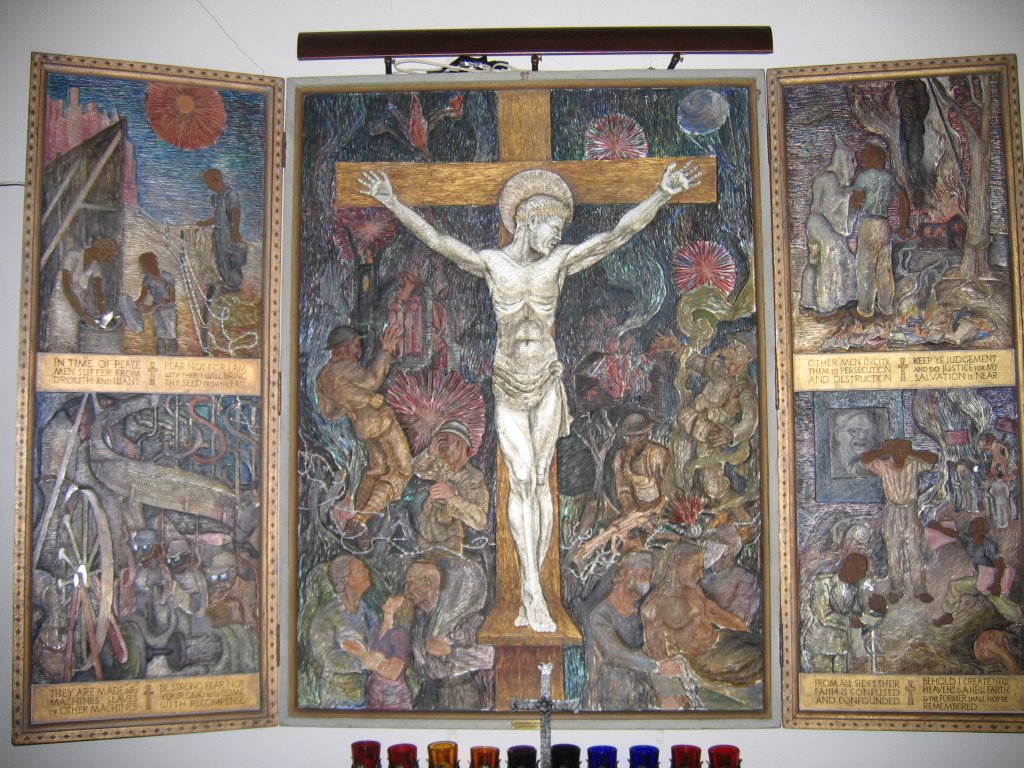
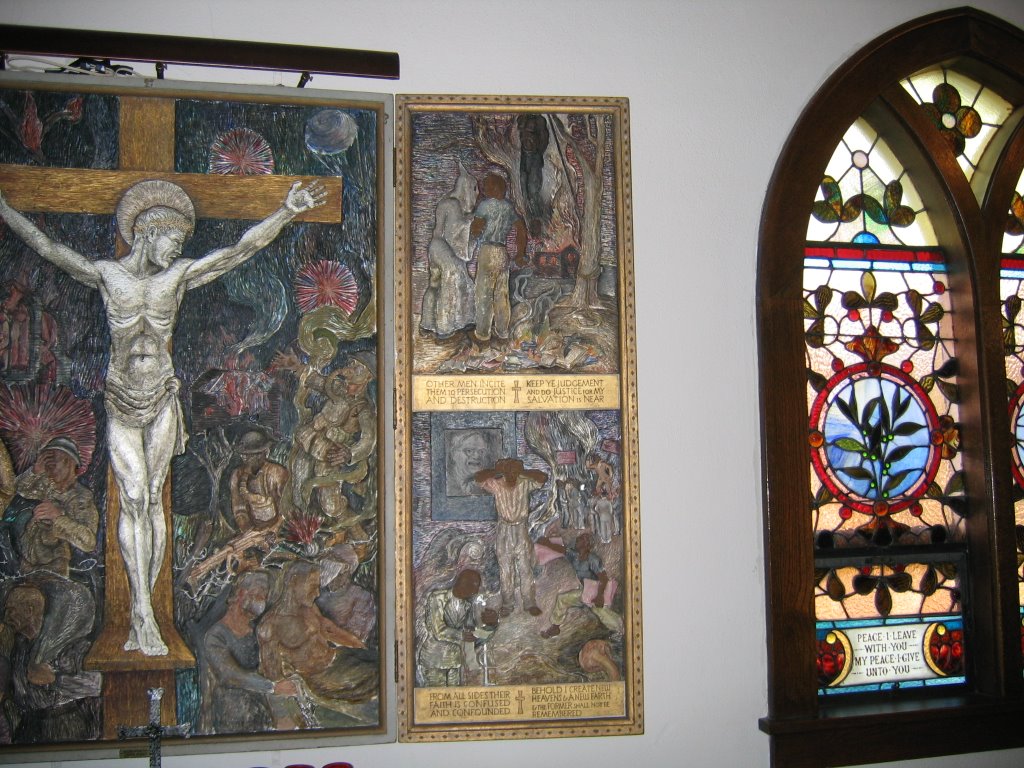
Tryptich in the Chruch of the Resurrection
These are some photographs of the tryptich that hangs in the worship space of the Church of the Resurrection where I serve. It is a graphic portrayal of some of the attrocities of the 20th century: mustartd gass in WWI, lynchings, american sweat shops. Over these images hangs Jesus on the cross. This artwork keeps me mindful of two things: 1) Jesus, that is to say God incarnate is present in our suffering, 2) We are to stand with Jesus to change the world to prevent these atrocities.



Thursday, August 17, 2006
Church of the Resurrection Inspired Collage
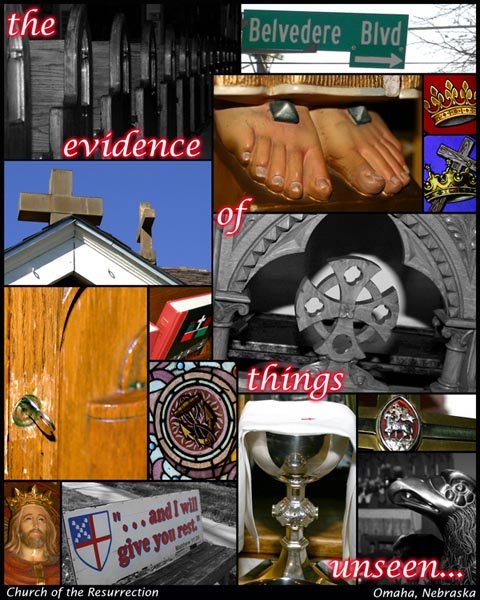 This Collage was created by Alison Black, a former Resurrection House intern and COR health minister who now lives in Leavenworth, Kansas with her husband Stephen and their two cats.
A print of this collage will be part of the silent auction at the Resurrection Jam in October.
long time no blog
I haven't blogged in what seems to be a very...very...long...time. In actuallity it has only been about two months, which flew by for me. However, in hindsight, it seems like a life time ago since the end of General Convention 2006. A lot has happened in the passing time with senior high camp and junior camp swallowing most of my attention.
Camps went really well! With the help of some amazing volunteers--especially my wife Jodie--I poured my heart and soul into the camps. All our hard work paid off. From senior high camp where we trained youth as peer ministers we had five outstanding new junior counselors emerge for Junior camp. At Junior camp we had an outstanding time with campers learning to fully rely on God and to share God with each other. The Bishop said to me the other day that when he visited and celebrated at the closing Eucharist he had never seen a group of 4th-8th graders so focused in worship in his life. I am proud of what we did with the camps. Both camps grew by at least 30% and also the Christ centered, participant focus was higher. But...despite all this, I think I might have gotten more out of camp then the campers did.
There are two moments I would like to share: a sun set and a prayer. I was walking back from the activity building to the caffeteria one evening and saw this stupendous sunset. Camp Comeca, a Methodist Facility we rent space from, is located on possibly the only hill in central Nebraska. To get there you are driving along through corn fields and then boom...there's this range of hills with Comeca on top. From atop this hill you can see a great distance because there is nothing to block you line of sight. The corn is high here, but not that high. Possibly, if the skies are clear enough, you might even be able to see Vegas from atop Comeca. Consequently, I had a great view of this sunset!!!! A great view...and it hit me. Right in that moment I had an epiphany. The God that created that sunset, the God that makes stars and planets, atmospheres and colors, hills and corn and human eyes, the God that keeps all these things inbalence so there can be life, the God that is powerful enough to do all cares about little old me. That is grace. Once upon a time a wise man described Grace to me as something good we get that we don't deserve. I certainly do not nor could I do anything to deserve the care or attention of the supreme creating God, but yet I have it. You have it. All have it. Grace, indeed.
The other experience was at our evening prayers one night. We were praying the Song of Simeon, which was first uttered by the prophet Simeon in the Temple at Jesus' presentation eight days after his birth. Simeon recognized God in the infant Jesus. A moment so powerful he was inspired to proclaim,
God's Peace,
Jason+
Camps went really well! With the help of some amazing volunteers--especially my wife Jodie--I poured my heart and soul into the camps. All our hard work paid off. From senior high camp where we trained youth as peer ministers we had five outstanding new junior counselors emerge for Junior camp. At Junior camp we had an outstanding time with campers learning to fully rely on God and to share God with each other. The Bishop said to me the other day that when he visited and celebrated at the closing Eucharist he had never seen a group of 4th-8th graders so focused in worship in his life. I am proud of what we did with the camps. Both camps grew by at least 30% and also the Christ centered, participant focus was higher. But...despite all this, I think I might have gotten more out of camp then the campers did.
There are two moments I would like to share: a sun set and a prayer. I was walking back from the activity building to the caffeteria one evening and saw this stupendous sunset. Camp Comeca, a Methodist Facility we rent space from, is located on possibly the only hill in central Nebraska. To get there you are driving along through corn fields and then boom...there's this range of hills with Comeca on top. From atop this hill you can see a great distance because there is nothing to block you line of sight. The corn is high here, but not that high. Possibly, if the skies are clear enough, you might even be able to see Vegas from atop Comeca. Consequently, I had a great view of this sunset!!!! A great view...and it hit me. Right in that moment I had an epiphany. The God that created that sunset, the God that makes stars and planets, atmospheres and colors, hills and corn and human eyes, the God that keeps all these things inbalence so there can be life, the God that is powerful enough to do all cares about little old me. That is grace. Once upon a time a wise man described Grace to me as something good we get that we don't deserve. I certainly do not nor could I do anything to deserve the care or attention of the supreme creating God, but yet I have it. You have it. All have it. Grace, indeed.
The other experience was at our evening prayers one night. We were praying the Song of Simeon, which was first uttered by the prophet Simeon in the Temple at Jesus' presentation eight days after his birth. Simeon recognized God in the infant Jesus. A moment so powerful he was inspired to proclaim,
Lord, you now have set your servant freeWe prayed this prayer at camp and I as looked out at the campers, these small children that carry the light of Christ in them, I was set free as God has promised. I saw God in them, a vision of Hope. Each and everyone one of them has the light of Christ in them, and--in the words of Louis Armstrong--oh, what a wonderful world. What a wonderful world we could have if we inspire these Christ bearing children to share thier light with the world.
to go in peace as you have promised;
for these eyes of mine have seen the Savior,
whom you have prepared for all the world to see:
A light to enlighten the gentiles,
and the glory of your people Israel.
God's Peace,
Jason+
Friday, June 23, 2006
Bishop Joe's Summary of General Convention
Below you will find Bishop Joe Burnett's summary of the 75th General Convention of the Episcopal Church USA. Enjoy!
MINISTRY MEMO
A MONTHLY COMMUNICATION
TO Clergy, Wardens and Lay Leaders of the
Diocese of Nebraska
June 23, 2006 (Post General Convention issue!)
From the Bishop
Dear Brothers and Sisters in Christ,
The following is a brief summary of actions from the 75th General Convention of the Episcopal Church, which concluded its nine day triennial gathering in Columbus, Ohio on Wednesday evening, June 21. I will be offering some personal perspectives on these developments which will be sent to you in a separateemail as soon as editing is completed.
This convention was historic, of course, in that the Bishops elected—and the Deputies endorsed the election of—the first female Presiding Bishop, the Rt. Rev. Katherine Jefferts Schori, Bishop of Nevada. Jefferts-Schori has promised to focus on mission in her nine year tenure as Presiding Bishop. Indeed, by far the overarching theme and work of the entire convention focused on global mission and reconciliation. Resolutions calling for the funding and implementation at all levels of the United Nations Millennium Development Goals(MDG) received wide support. Deputies and bishops also addressed issues of violence and poverty in areas of the world under oppression or torn by war and internal violence. Far reaching steps in domestic mission and evangelism, including supporting leadership training and raising funds for new church planting, were also embraced. Clearly worded statements apologizing for the Episcopal Church’s complicity in the historic sin of racism, and specifically in supporting slavery, also called for taking stock of ways in which the church might begin to make amends for past wrongs with living generations of those affected by these actions.
Blessed with the presence of many ecumenical and interfaith representatives,the church took steps to further its conversations and relationships under the auspices of its ecumenical office, and in particular approved an agreement for “interim Eucharistic sharing” (intercommunion) with the United Methodist Church, which includes recognition of the UMC as a member of the one, holy, Catholic and apostolic Church in which the Gospel is rightly preached and taught, and encourages the development of a common Christian life between the two bodies. The agreement permits common, joint celebrations of the Eucharist (Holy Communion) between the two churches.
Deputies also concurred with bishops in adopting a resolution calling for equal representation of women and men on all decision-making bodies within the church at local, diocesan and national levels. This recommendation originated with the 2005 meeting of the Anglican Consultative Council, an international body.
The deputies also concurred with the House of Bishops in a mission initiative resolution for the New Orleans area that will gather data that can be used to advance evangelism elsewhere in the church.
Additional resolutions were passed that came from the special committee that considered resolutions in response to the Windsor Report, a document issued by an international panel of Anglican leaders in response to strains in parts of the world wide Anglican Communion following the consecration in 2003 of an openly gay bishop living in a partnered relationship. The convention affirmed the strong desire of this church to continue as a full and faithful partner in the world wide Anglican communion, while at the same time reiterating the historic separate and independent status of the churches of the Anglican Communion. The "Windsor process" to discern the nature and unity of the church, and the report's call for a listening process, were also affirmed. In particular, the convention approved a resolution that calls on bishops and Standing Committees to "exercise restraint by not consenting to the
consecration of any candidate to the episcopate whose manner of life presents a challenge to the wider church and will lead to further strains on
communion."
Deputies concurred with the House of Bishops in opposing the criminalization of homosexuality, opposing state or federal constitutional amendments that prohibits same-gender civil marriage or civil unions and affirming the civil rights of gays and lesbians. Another resolution reiterates Episcopal Church support of gay and lesbian people as "children of God who have a full and equal claim with all other persons upon the love, acceptance, and pastoral concern and care of the Church."
Deputies also concurred in creating a new task force to study aspects of church disciplinary canons. Proposed changes would have replaced the current court-oriented system with a multi-layered approach intended to focus on mediation and reconciliation which included a controversial provision that would subject certain lay leaders to the new canons. After hearing significant concern about the proposal,particularly about subjecting laity to ecclesiastical discipline,the legislative committee moved to refer the continuing work to the task force for continued revisions over the next three years.
Thank you for your prayers during these long and tiring days. Your deputies and alternates served you and the wider church well in their prayer, work, and
deliberation. We are glad to be home!
Faithfully in Christ,
+Joe
Wednesday, June 21, 2006
Sermon from Trinity Sunday
I wasn't able to post this before heading off to General Convention; so this Sermon was delivered on June 11th, 2006. The readings were: Exodus 3:1-6, Romans 8:12-17, 11 June 2006John 3:1-16
"For God so loved the world that he gave his only Son, so that everyone who believes in him may not perish but may have eternal life."
I speak with you today in the name of the loving God. Amen!
Several years ago, when I was a camp counselor, and still to this day when I’m running retreats, I prefer for participants not to wear watches. I’ve noticed that campers or retreatants who wear watches are always wondering what’s next. They tend, as my wife says, to anticipate rather than participate. I don’t like this phenomenon. Going to camp or being on retreat is a chance to be fully present in the moment; not to worry what comes next; not to be constantly pulled by the commitments and expectations of our day to day agendas.
Now, I could simply inform people of this opportunity. I could explain to them my reasoning and show them the advantages to letting go of their watches for awhile. I could wax eloquently and with much passion about how God is present with us in this very moment and to constantly worry about what comes next is a rejection of God’s grace present in the present. But where would the fun be in that. Instead I prefer to be a rascal. Therefore, when a camper asks what me what time it is, I more likely than not answer with some sort of comment like, “penguins don’t wear shoes, or Ice Cream has no bones.” I must confess to taking a distinct guilty pleasure in watching the camper’s confusion. It really brightens my day to bewilder and frustrate someone’s expectations.
My intention—beyond selfish entertainment at the expense of others—is to draw people into the here and now. My hope is to instigate awareness to what is going on right now in this moment because that is where we are most likely to hear God. See there is more going on in this moment than we are aware of. Too often we are clouded by our limited perceptions of things. We have particular categories, boxes in which we place every thing and every person. As long as these people and things function within our conceptions of whom and what they should be we are able to blithely mosey along without paying much attention, without giving ourselves to the moment or each other.
We do this in all aspects of our lives, even our faith. Furthermore, we have been doing this since the beginning of time. Look at our dear brother Nicodemus. Nicodemus was, as one commentator put it, “thoroughly informed and utterly inert,” and “was under the influence of a religious tradition that taught a faith that was to be managed, protected, and guarded.” Do this. Don’t do that. Complete the checklist. That was the path to holiness, the path to God. Now, Nicodemus found himself in a quandary. See, on the one hand he could not deny that Jesus was doing Godly things—signs that could only be done by one who was at least on God’s side. But on the other hand he couldn’t place limits on Jesus, he could not categorize Jesus. Jesus would not fit into one of Nic’s well crafted boxes of understanding. Nicodemus wanted an exact method, a procedure, a set of rules to live by. Jesus gave him poetry. Nicodemus wanted a course; a path to follow that led him in a guaranteed direction to a pre-determined place. Jesus says the wind blows where the wind blows. Nicodemus wanted to know the cause so he could predict the exact effect. Jesus calls him to relationship.
This is what a I call a swift kick of Christian love. Jesus is trying to crack open Nicodemus mind, trying to get good old nick to realize the connection between the physical and spiritual.
Now many a theologian over the years has interpreted this passage, and the passage we read from Paul this morning, to mean that there is a separation between the body and spirit and that the spirit or spiritual things are all that Christians should be concerned with. They are quite frankly wrong.
Consequently, this misinterpretation has led to really bad Christian behavior. For example, it has become at times in the church’s history, fashionable to mutilate the body in order to free the spirit. More common in our society today is the idea that since the spirit is saved then what we do with creation doesn’t matter. Since our souls are redeemed, we are free to use creation, to consume our natural resources with ne’er a second thought. Finally, a separation of matter and spirit leads some to think that the church should not be concerned about the social order. That the church and its members should be about ministering to the spiritual needs of people only. The church should be only concerned about the physical in order to relieve the symptoms of poverty and injustice but never question why poverty and injustice persist.
This interpretation and the resulting behavior are wrong because that is simply not what Jesus says. Jesus says to Nicodemus that one must be born of BOTH water—that is to say matter, physical substance, the stuff of creation—AND the spirit. Later in today’s Gospel Jesus says the most famous piece of scripture in
Jesus today is calling Nicodemus into relationship. Jesus is calling him away from a personal faith based on completing a checklist. Jesus is calling him into a faith that is relational. Jesus calls us to see the connection between heaven and earth, between body and spirit. This is hard for Nicodemus and us, because a checklist faith is ordered. A relational faith is messy. A relational faith requires us to be open to the spirit. Open to the fact that the spirit may lead us somewhere where we never thought we might go.
Today is Trinity Sunday. Now it is traditional to have assistant priests and curates preach on Trinity Sunday. It is a rite of passage for us to stand up and try and explain the Trinity. So I went looking for a decent definition, one that was simple, relatively short, and adequately explained the Trinity. I failed in this quest. People have written tomes upon tomes about the trinity. They have used philosophical language, mathematical language, sign language and symbols. But they just can’t get it done. This is because we can categorize God. We can’t with precision describe God completely. What we know of God is in relationship not as an item. The doctrine of the trinity is the teaching of God in relationship. Whether we say “father, son, and holy spirit” or “speaker, word, and breath” or “creator, redeemer, and sustainer” we are communicating a relationship. We are communicating our understanding that God is in relation with us in multiple ways that some how make us one as God, Jesus, and the Spirit are one.
To stay in relationship we must remain open. We must be open to God speaking the word Jesus Christ through the Spirit breath. We neither know where the wind comes from nor where it is headed, but if we are open God will lead us.
This week the General Convention of the Episcopal Church will gather to do business. We only do this once every three years, which is good. We should be about living Christ in our daily lives, not constantly sitting in business meetings quibbling over minute points of grammar. So, once every three years is enough. This convention, as all of them have, will confront questions of relationships—our relationships to money, our relationships to power, our relationships with each other. I is my hopeful prayer that the Bishops and Deputies of the general convention are the wisdom and stamina to remain open to the Spirit on every issue, open to the fact that we can not predict what God is willing to do in order to show us God loves us.
Now, just as the deputies and Bishops do not represent a specific constituency—rather they are to vote their conscience on every topic—they can’t live our faith for us either. Therefore, I too pray for all of us to remain open to God. Listening with open hearts to hear what God wants us to do in every moment, every relationship, and every breath of our lives.
Being open starts today as we kneel and pray. Being open starts today as we confess our sins, admitting to God and our neighbor when our hearts and minds have been closed to heaven and earth. Being open starts today when we walk this aisle and come to God’s heavenly table where we receive and consume the Body and Blood of Christ to go be the Body and Blood of Christ. Amen!
Tuesday, June 20, 2006
Home again
I am home from General Convention, and boy was I ready to come home. There is much exciting work to be done here, and I was feeling disconnected being gone. I am working on camp stuff and happening stuff this week. If you haven't gotten your camp applications in, please do so soon. I love you all, but get them in!!!!!!
Please forgive the pun, but in general I enjoyed General Convention. There will be much hoopla in the following days and months about the election of woman as Presiding Bishop, and even more about the Windsor Report. However, these are not the most radical and progressive things that occurred at General Convention.
If you read the papers and/or consume other forms of public media you would think that all we talked about at General Convention was sex. This could not be further from the truth. There was a lot of talk about ministry, even more about mission, and the most was about money. It's a business meeting; so, it makes sense that money dominated the debate. From these discussions of ministry, mission, and money the Episcopal Church has done the most radical thing it could at general convention. We have heard the call of God in the scriptures to charity AND justice. Consequently, we have adopted the millennium Development Goals as tools to focus our mission. So you tell me which is more radical: electing a woman to an executive position, or a denomination that represents less than 1% of the U.S. population deciding to eradicate extreme poverty in nine years? My vote is with the later!
Monday, June 19, 2006
From the Desk of The Rt. Rev. Katharine Jefferts Schori, Bishop of Nevada, Presiding Bishop Elect of the Episcopal Church USA
I quote this from the nominating commitee for the election of the presiding bishop. The full bios of all the candidates can be found at the Episcopal Church USA Website.
“What do you consider the most important priorities
for the Presiding Bishop?”
“What do you consider the most important priorities
for the Presiding Bishop?”
The Presiding Bishop keeps us focused on the Reign of God, through unceasing attention to mission in the context of baptismal ministry. Christians and their communities are meant to be transformative elements in this world, laboring to create something much more like God’s Reign. The church’s work is to recognize where we have not yet attained God’s dream, speak gospel to that reality, and equip and empower all the baptized to do the work of transforming those places of not-yet. There are two obvious foci for our ministry: moving our sanctuaries into the streets to encounter and transform the bad news of this world; and implementing the Millennium Development Goals, which provide a signal opportunity in this age to realize the dream of God for all creation.
This church must embrace and celebrate all the diverse cultures, languages, and origins of the many parts of the Episcopal Church – Haiti, Taiwan, Province IX, the Churches in Europe, Virgin Islands, as well as the many cultures within the U.S. – First Nations, African-American, Spanishspeaking, Asian, and all Anglo varieties. None is more important than another; all are essential to the transforming work of the Body of Christ. Ultimately, the Presiding Bishop’s role is one of bridge-building and boundary crossing. If we are to reconcile the world, we must be bold enough to enter unfamiliar territory and partner wherever necessary to build toward the Reign of God. The Body is strengthened as all parts are honored, whatever their color or language, or liturgical, theological, or political stripe. God is to be found in that wilderness of difference, and reconciliation requires the crossing.
I heard the Breath of God!
Yesterday we elected a new Presiding Bishop. There is no surprise in that statement. It was on the schedule for the 18th of June long before we arrived at General Convention. The surprise came in the election of Rt. Rev. Katharine Jefferts Schori, the first woman Presiding Bishop. When they announced the name in the House of Deputies there was a collective intake of breath from all present. I do believe this was us breathing in the Holy Spirit, and oh what a beautiful sound.
So, now I must make yet another confession. When I heard the slate of nominees for the presiding Bishop, I had not even considered Bishop Schori...not because she is a woman. I am married to a middle school math teacher. I have no doubts about the administrative leadership abilities of women in general. What I must confess is a lack of faith in the House of Bishops to truly consider each candidate. I assumed that they would write Bishop Schori off; so I wrote her off. There is an old adage about making assumptions. I thought I had learned it well a long time ago, but I guess I needed a refresher.
I leave General Convention today. I am eager to return to Nebraska, because there is a tremendous amount of work to be done before I leave for vacation next week. However, a lot of the weightier issues will be handled in the next few days, i.e. the budget, and Windsor Report resolutions. So, I'm a little a sad to miss those moments. I am more sad to once again leave friends that I had not seen in awhile. I got to spend considerable time with one of my roommates from seminary, Fr. Bob Griffith, and I was once again reminded how much I miss a lot of my friends. I wish them God speed, and I hope to run into them again someday!
Sunday, June 18, 2006
Comments
I just enabled comments so that yall can reply if you so choose. It aparently only shows it on new posts. Therefore this post is simply to give you the chance to comment on any previous posts.
Intergirty Eucharist
Greetings,
On Friday night of General Convention, I was blessed to be able to attend the Eucharist Hosted by Integrity (a grass roots advocacy group for the full inclusion of the GLBT community in the Episcopal Church). I say I was blessed for three reasons:
Jason+
On Friday night of General Convention, I was blessed to be able to attend the Eucharist Hosted by Integrity (a grass roots advocacy group for the full inclusion of the GLBT community in the Episcopal Church). I say I was blessed for three reasons:
- I actually got in and got a seat. Trinity Episcopal church in downtown Columbus was completely FULL. Your read that right. An Episcopal Church was filled beyond capacity and it was neither Christmas nor Easter. They literally had to turn some people away because of safety reasons. Rarely, in my time as an Episcopalian, have I worship so closely with so many--closely in the we were literally sitting shoulder to shoulder snese. Would it not be wonderful if all our churches were overflowing every Sunday. Yes, our bodies might be a bit uncomfortable, but our souls would be the better. My first spiritual director taught me that our soul, our lives of faith, grow in community. They grow when we have to rub up against each other, when we can not isolate ourselves in a space where our egos and perceptions go unchecked. Plus, with that many people in a small space, singing becomes a whole lot of FUN!
- I was blessed to see so many from Nebraska at the Eucharist. The Bishop and Marty, Dean Hurly, Ruth and Larry Jaynes, Jody Kressenbock from Crete, and probably more that I could not see in the crowd were all there. Others wanted to attend, but either got there too late and it was full, or they went to another Eucharist hosted by the office of Hispanic Ministries--an equally attended and energetic worship experience.
- I was blessed to hear the Bishop of New Hampshire preach the Gospel. His message was simple: Love! Love those that love you and, more importantly, love those that don't love, and even hate, you. If ever there was a person that had a right to be angry, to be mad, to be vengeful it is him. I can not imagine what is like to have my life threatened simply becuase of how I was born. I can not imagine what it is like to have vicious hateful things said about and to me simply because of whom I love. I can not imagine having to wear a bullet-proof vest under my vestments simply to celebrate the Eucharist. Bishop Robinson has experienced all these things many, many times over. Yet, he is hopeful, kind, and loving. In the face of the negative and hateful energy that has been sent his way he has consistently responded with love and kindness. Indeed he is a faithfilled man. Indeed he is a role-model. Indeed he is an amazing pastor. Once again, I am sure that the Diocese of New Hampshire elected him, not because he is gay, but because he is an amazing pastor. I am a pretty cynical guy, and out of arrogance am pretty judgemental of all preachers. I was in tears from this sermon: tears of repentence for when I have not been loving, tears of wonder at the light of Christ shining from this man, and tears of hope that we in the pews would be inspired to love as Christ loves and make the world a merrier place.
Jason+
Friday, June 16, 2006
Keeping On Keeping On
I am a wee bit tired, and I'm not even a deputy. The entire experience of people, sounds, and things around this convention is outstanding, but requires a tremendous amount of energy to simply absorb it, much less process it all. Therefore, it is easy to be compassionate for the deputies and bishops who are working so hard. Regardless of whether I agree with them or not on issues, it is quite easy for me to pray that God give them the strength and stamina to excercise thier duties well.
Last night I attended the Presiding Bishop's forum on Reconciliation. He had gathered four speakers to promote the ministry of reconciliation as the primary mission of the Episcopal church. It was an outstanding forum, filled with passionate inspiring rhetoric that also included practical ways to get involved in the ministry of Reconciliation. Here are a few of the ways to be involved:
Jason+
Last night I attended the Presiding Bishop's forum on Reconciliation. He had gathered four speakers to promote the ministry of reconciliation as the primary mission of the Episcopal church. It was an outstanding forum, filled with passionate inspiring rhetoric that also included practical ways to get involved in the ministry of Reconciliation. Here are a few of the ways to be involved:
- Whenever someone who has been watching the news asks you about the "contreversies of the church" begin your response witht the statement that the churches mission is reconciliation and we therefore must have people of different minds coming together.
- ERD!!!!!!! Episcopal Relief and Development is an amazing institution with a proved track record of emergency response and continuing aid.
- The ONE Episcopalian Campaign: Just as ERD deals with the charity side of the reconciliation coin this, movement deals with the justice side. To paraphrase Dr. King we are to be the Good Samaritan, but the we must work to make the Jericho Road safe to all travelers as well.
- Prayer! Thomas Merton said(again paraphrasing) that you can't be a contemplative for long without eventually enaging the world for the betterment of it. Conversely, you can't engage the struggles of this creation without burning out if you aren't a contemplative. We must stay active in both out private prayer lives and our corporate worship. It's like what the singer/rockstar Bono once wrote in a lyric, "if you want to learn how to fly, you must learn how to kneel."
Jason+
Wednesday, June 14, 2006
Multitude of Things
So in the first two full days of this convention we have:
- Attended a committee hearing on Millenium Development Goals
- Participated in two sessions with author Lauren Winner on Sabbath Keeping and Spiritual Writing.
- Interviewed a prospective intern for the Resurrection House program
- Went to a reception for world missions
- Attend a U2charist (more on this in a moment)
- Purchased a table for and helped set up the booth to advertise the intern programs
- Met countless people
- Met several old friends I had not seen in awhile
- Attended a convention Eucharist
- Examined the exhibit booths with my roommate from seminary that works for the pension fund.
- Took a nap
- attended a working session of the special committee on the Windsor report: no testimony from non-committee members just word smithing by the committee
- Worked at the Intern booth
- attended receptions for General Seminary and the Episcopal Public Policy Network
- attended a hearing of the Program, Budget, and Finance Committee
I really can not describe all of these items in detail, because that would take all night. But I would like to offer a couple of reflections on the U2charist and the Program, Budget, and Finance Committee hearing.
A U2charist is an Episcopal worship service of communion with music by the band U2 and a message regarding the MDGs and the ONE campaign. They expected about a hundred people to attend and had over 700. Many would think that only "youth" would attend, but there were people of all ages there. Bishop Curry of North Carolina preached. My goodness this man can preach. He is one of those people that could read the phone book and you would want to give your heart to Jesus. It was a wonderful experience. The bishops message was simple: We can live out our witness of the love of Christ, we can practice what we preach by fulfilling the MDGs.
Second in the P,B, and F committee hearing I heard several Episcopalians speak on behalf of items in the budget ranging from Peace and Justice to Christian Education, from Navajo Ministries to support for ministries at Traditionally African American Colleges. My first reflection was of pride in the passion and eloquence with which the speakers expressed themselves. Second was that none of them brought forth a bad idea or a insignificant program; so, to which one do we say no? I in no way envy the people on that committee. There is so much work to be done and so many capable Episcopalians wanting to get the work done, but we don't have the funds to adequately fund all of them to the extent that is needed. God help us!
Monday, June 12, 2006
General Convention Night One
Well, we left Omaha yesterday, camp in Illinois last night, and arrived in Columbus, OH at 2:00 p.m. local time for the 75th triennial General Convention of the Protestestant Episcopal Church in the United States of America. That's a lot of words to say Jodie and I are at the Episcopal Church bidness meeting. Today is also, our second wedding anniversary; so, since Jodie's family lives close to here, they came and took us out to dinner tonight before all this got under way.
I am excited about the number of peopl at the young adult festival (about 150 or so) and the number of young adults here for other reason: volunteers, activists, staff, and even as DEPUTIES!!!! It is great to see people in the their 20s/30s as part of the decision making of the church! It has also been nice to run into old friends and aquaintences. The Episcopal church is a small church; so if you sick around it long enough you run into a lot of the same people.
Tomorrow morning I'm going to an open committee meeting concerning a piece of legislation asking every person, congregation, and diocese to commit 0.7% of thier income towards ministries working on the Millennium Development Goals (MDGs). Their are 8 MDGs that call us to fix major problems in the world. Truly, for the first time in history, abject poverty is solely a political problem. The human race has the ability to feed, clothe, and provide basic medical care for itself. The fact that there are people who live at less than this minimal level is a social/political problem. If we are looking to be reconciled to each other the way we are to God--to love God, neighbor and oursleves in that order--then we should be about organizing our lives, our communities, our states, and our world so that all can have a chance at life. The legislation is about making the call for us to commit our money and ourselves to these goals. You can probably guess that I'm already in favor if it, but I haven't, as of yet, made this type of finanicial commitment. So, after the committee I'll have to swing by the exhibit hall and find some ministries I can support that work in these goals.
Time to sleep!
Subscribe to:
Posts (Atom)