Thursday, November 30, 2006

Newsletter Reflection

This reflection was prompted by a posting on hypersync by my buddie Bob G+

“The American Catholic writer Flannery O’Connor was once invited to a New York literary salon. Over dinner the hostess, who had the power to make or break writers’ careers, said that she believed the Eucharist was merely a “symbol”. Flannery O’Connor replied: “Well, if it’s a symbol, to hell with it.” Later, O’Connor wrote that there was no other answer she could have given, because the Eucharist “is the centre of existence for me; all the rest of life is expendable”.

The previous paragraph was first published in The Catholic Herald as the preamble to an interview with Archbishop of Canterbury Rowan Williams regarding the meaning of the Eucharist. The Archbishop when asked affirms O’Connor’s sentiment if not her language.

I am often asked what happens in the Eucharist. Does the bread and wine actually become the body and blood of Christ? And if it does, isn’t that kind of gross? The cheap cop-out answer is of course, “The Eucharist is a mystery which we will never completely understand.” This answer is true if not very helpful.

So, what do I believe the Eucharist is, or what do I believe happens in the Eucharist? First, I believe that relative to God human beings are pretty dim. Consequently God has to overcome our relative lack of comprehension in order to communicate God’s love for us. We see an overarching story of God trying to get through to us the extent to which God wants to be in relationship with us. From Abraham to Moses to David, from Sarah to Deborah to Esther and to Mary, the Scriptures tell of God’s desires to be in so deep a relationship with us that we would be one. The climax of this story is of course Jesus—the word of God made flesh. Looking at Jesus’ story, he even had trouble getting across the message; so finally he says look, “I am the word of God made flesh. I and God are One. I want you and I to be One as God and I are One. So, I’ll become bread and wine. You eat the bread, drink the wine and then you and I’ll will be one. Get it?” The disciple’s reply probably something along the lines, “Not really, but whatever you say boss.”

I do not really “get” the Eucharist in a completely definable way, in the way say St. Thomas of Aquinas explained it. I do however know that God loves me and wants me to encounter that love. God has infinite ways of communicating that love, some I am aware of and some I’m not. One that I am acutely aware of is the Eucharist. In the bread and wine, in the body and blood of Christ, we encounter the risen Christ. The same Christ the disciples encountered, and all the faithful have encountered. As the Archbishop of Canterbury says in the same interview, “The Eucharist is not a visual aid and it’s not a jog to memory. It’s an event, an encounter. And if it is not an event in which some utterly earth-shaking change occurs, if it is not an encounter with the risen Christ, well, indeed, to hell with it.

Ipod Shuffle 8:45 am cst

Here's this mornings output:

  1. Sparks, Wynton Marsalis, Live Itunes Session
  2. I Let a Song Go Out of My Heart, Dizzy Gillespie and Chet Baker
  3. We Have Been Make One Landon Whittsett
  4. I Still Haven't Found What I'm Looking For, U2
  5. Oh, Happy Day, soundtrack of Sister Act 2
  6. New York City, Norah Jones with the Peter Malick Group, The Remix
  7. Alone Together, Miles Davis, Blue Moods
  8. God Help the Outcasts
  9. I Get Lifted, Theryl De Clouet, A Celebration of new Orleans
  10. Pro Defunctus, Chet BakerEnsemble, Chet Baker Ensemble (Remastered)
Ipod Shuffle Game
Via Bob G+ of hypersync

Via:
Fr. Jim Tucker of Dappled Things:

The rules, for bloggers who want to play:

Get your ipod or media-player of choice, select your whole music collection, set the thing to shuffle (i.e., randomized playback), then post the first ten songs that come out. No cheating, no matter how stupid it makes you feel!

Wednesday, November 22, 2006

Presiding Bishop writes Bishop Schofield

Greetings,

Below is a pastoral letter that the Presiding Bishop wrote to the bishop of San Joaquin. As a personal editorial comment, I would say that we have a strong leader, who presents cogent analysis of the way things are and points us to how things ought to be. I am proud of our Primate!

God's Peace,
Jason+

Via ENS

Presiding Bishop Katharine Jefferts Schori — concerned by current affairs in the Fresno-based Diocese of San Joaquin, California — has written to its bishop, the Rt. Rev. John-David Schofield. The diocese, which is scheduled to meet in convention December 1-2, includes an estimated 10,000 Episcopalians in some 48 congregations. The text of Jefferts Schori’s November 20 letter follows.

November 20, 2006

The Rt. Rev. John-David Schofield
Diocese of San Joaquin
4159 E. Dakota Avenue
Fresno, California 93726

My dear brother:

I have seen reports of your letter to parishes in the Diocese of San Joaquin, which apparently urges delegates to your upcoming Diocesan Convention to take action to leave the Episcopal Church. I would ask you to confirm the accuracy of those reports. If true, you must be aware that such action would likely be seen as a violation of your ordination vows to “uphold the doctrine, discipline, and worship of Christ as this Church has received them.” I must strongly urge you to consider the consequences of such action, not only for yourself but especially for all of the Episcopalians under your pastoral charge and care.

I certainly understand that you personally disagree with decisions by General Conventions over the past 30 and more years. You have, however, taken vows three times over that period to uphold the “doctrine, discipline, and worship of the Episcopal Church.” If you now feel that you can no longer do so, the more honorable course would be to renounce your orders in this Church and seek a home elsewhere. Your public assertion that your duty is to violate those vows puts many, many people at hazard of profound spiritual violence. I urge you, as a pastor, to consider that hazard with the utmost gravity.

As you contemplate this action I would also remind you of the trust which you and I both hold for those who have come before and those who will come after us. None of us has received the property held by the Church today to use as we will. We have received it as stewards, for those who enjoy it today and those who will be blessed by the ministry its use will permit in the future. Our forebears did not build churches or give memorials with the intent that they be removed from the Episcopal Church. Nor did our forebears give liberally to fund endowments with the intent that they be consumed by litigation.

The Church will endure whatever decision you make in San Joaquin. The people who are its members, however, will suffer in the midst of this conflict, and probably suffer unnecessarily. Jesus calls us to take up our crosses daily, but not in the service of division and antagonism. He calls us to take up our crosses in his service of reconciling the world to God. Would that you might lead the people of San Joaquin toward decisions that build up the Body, that bring abundant life to those within and beyond our Church, that restore us to oneness.

I stand ready for conversation and reconciliation. May God bless your deliberation.

I remain

Your servant in Christ,

+Katharine

The Most Rev. Katharine Jefferts Schori
Presiding Bishop and Primate

Wednesday, November 15, 2006

Even more conversations about power

Greetings,

The IEF training in community organizing continues to go well. So far it has mostly been theory, but I have been assured that today we will get to practice some of the techniques they have been alluding to.

The thing that I think that I am starting to understand is that I have to claim the power of my office. Whether I like it or not, whether I am suppicious of having power or not, the fact remains that clergy have power. The more important question is how will I wield the power of my position. To deny it is simply to waste it. To be autocratic is inefficient and anti-biblical. Therefore, what the trainers called informed judgements and relational power, are keys to wielding power with integrity to the values I wish to hold. People are changed by relationships not by readings or sermons. Therefore, producing informed judgements in people is done by building relationships with people. This will in turn allow you to exercise relational power the power of broad based group that wants a change. This helps reduce the temptive forces that seduce a powerful person to curruption. To bring this into Christian language, it is to be a servant leader or spiritual leader instead of an autocratic leader.

Tuesday, November 14, 2006

More conversations about power

The two questions for today's training are 1) how can we operate with power in the real world, and 2) how can we operate with power and maintain our integrity? Our session this morning began with a closer examination of the Athenian/Melian debate. We examined how both parties acted for behaviors we could imulate and those we should avoid. Most of the desirable behaviors emerged from the Athenians. They:
  1. Controled the debate.
  2. Want to talk to the many not the few
  3. Speech is blount and direct
  4. analyize the power dynamics
  5. Sought a compromise of mutual self interest
From these actions we noted behaviors that would be beneficial for us when negotiating with those in power.

  1. Have a specific agenda! Do not go to meet on a fishing exhibition. Know exactly what topic you want to discuss. Know what you want to say and stick to the script. Also, start the meeting and lay out the ground rules. Be diciplined about keeping yourself on topic and make the other side stay on topic as well.
  2. Work within reality! Organizing is about knowing not about hoping. Know what you have specifically, not an estimate and deal from that place--niether overstate not understate your position. For example if you know you can organize 10,000 people then that is what you say. Even if you have more people show interest in your topic you only have the 10,000 that you can organize. That is your power base and you should be clear about that.
The Melians on the other did somethings we should avoid. They:
  1. They are passive. They consent to the agenda and methods of the Athenians.
  2. They speak in vague terms appealing to hope and to "blood" (the assumed relationship they have with the spartans).
  3. They do not involve as many people as possible.
  4. Only concieve of two options. They want the Athenians to leave and do not accept any other terms despite the overwhelming force.
The biggest lesson here for me was that you have to analize the power structure and know what you can win in regards to context. If you can not get what you most want then change your wants.

It should be noted, however, that while the Athenians desired to act in moderation from there stance of dominate power, eventually they crushed the Melians. They excercised there dominate power in a destructive way which was against one of their own rules. That is to say they lost thier integrity. This eventually cost the Athenians the war of which the Melian debate was small part. So how do we act in a way that is from power but does not compormise our integrity?

As we dove into this we learned that the ethics of power emerge from how power is gained. We were given four methods of gaining power:
  1. Threat of force. This takes the most effort and is the weakest because it must be constantly maintained. Once the threat is removed or the threatened grow tired of the opression your power is negated.
  2. Controlled or slanted information.
  3. Habit or apathy (posses biggest problem for organizers. People will actually think you are making stuff up when you inform them of problems because it takes less energy then believing you.
  4. Mystery, Magic, Ritual, Custom (especially difficult for me since whether i want it or not power is often given to clergy).
  5. Informed Judgement: this is the strongest becuase it involves positive relationships. People come together to analize a situation and come to a decision about an issue or event. Hard to bring about because it easier to have an opinion than an informed judgement.
Apparently, if you gain power from developing informed judgements amongst groups of people, if you are working from developing relationships then you lesson the risk of losing integrity. Often times when the 'have nots' beome the 'haves', they begin to act like the people they overtook. Hopefully we are going to discuss more about maintaining integrity while claiming power.

Community Organizing Training Day One

Greetings,
I have journeyed to Kansas City to participate in Community Organizing training. Church of the Resurrection where I work is a member of Omaha Together One Community (OTOC)and this is the model of organizing that OTOC uses. I will be blogging this week about what I learn about myself in the experience and the techniques and materials they present to us.

We gathered for out initial session yesterday at 3:00 p.m. Our first activity was to tell a story of a time when we acted to make something happen. By an incidental utterance, I ended up going first and spoke of working as a team coordinator for Lutheran Outdoor Ministries of Ohio running day camps for elementary kids in various towns in Ohio. Everybody else proceeded to tell stories about engaging school boards, city councils, businesses, government agencies, and leaders. Now, Jodie reminded me that this isn't a competition and I agree with her. My story is important for me in that I began to hear my call to ministry. However, I often preached that what we experience in worship should be connected with what we do outside the church building. I am excited by what I can learn from the other participants, because they are actively trying to make the world a better place, not merely preaching about it.

Our second activity involved us "re-enacting" a dialogue of the Athenian overtake of the island of Melos. (I don't know what book this is from but the title of the portion given us is "Chapter 7: Sixteenth Year of War. The Melian Debate".) Now the rule during the role play was that the facilitator could interrupt. This was the only rule. It was emphasised to us that this was the ONLY rule. We proceeded with the role play, and after about three minutes the facilitator kicked me out of the room. I went outside and realized that the point was not to act out the reading but I had just given the facilitator more power then he really had. He was allowed to interrupt, but not to tell us what to do. Now, while I was sitting in the hall like a disobedient middle school student I could have patted myself on the back for figuring this out, but when I went back into the room and we went through three more groups doing the role play, I didn't say anything. Never did I confront his excessive use of power. I say excessive because the limit established was that he could interrupt, and he was over that limit. I didn't speak up for myself and I didn't speak up for other people when they were kicked out.

Second, during part of the role play I got to be on the side of the Athenians. The Athenians possessed far greater resources, especially military, over the Melians. I suggested to my small group of Athenians that we should go "off script" and be compassionate with the Melians. We agreed to try this and were making progress. However, I started to be more and more unyielding, less willing to compromise. I knew that we had the dominate military and that we could annihilate the Melians; so I was unwilling to concede anything. Why should I concede when I could dominate. The fictional power of this little exercise was able to seduce me to do things that I don't believe in. Power is certainly seductive and I must, must, be aware of my weakness to its wiles. I wanted to be a nice guy, but, as the facilitator put it, I didn't want it enough.

I am eager to find out what we will do today; more exploration of power, or how to engage with people in power, or how to organize a power base? We'll see.

God's Peace,
Jason+

Thursday, November 09, 2006

Hope meet Realism, Realism meet Hope

Greetings,

In November of 2004, my wife Jodie and I stood in Rockefeller Center in the middle of NBC's election coverage holding a sign that read "We believe in Ohio Democrats". It appears that our hope in Ohio Democrats specifically and Democrats in general was not misplaced rather the realization of that hope took a couple more years.

I am always very nervous of power. Therefore, I am glad that we no longer have a single ruling power; no more rubber stamps, blank checks, or tacit approvals. Now we have debate and contention. There no better check or balance of power than equal opposition.

All this being said, we are in need of a bit of realism here. First, if we think the Democrats will get to pass whatever they want at this point, we are stupid. President George H.W. Bush--I think--holds the record for vetoes in one term of office. That could very well be a lesson that President George W. Bush learned well.

Second, looking at the Democrats that won and the issues that people said were important in exit polls, I believe people often times were voting against Republicans instead of for Democrats.

What we did learn, or were reminded at least, is that in this country we have the option of changing our leaders frequently. It is a power that we should claim and exercise. Therefore, We, that is to say the faith community, have a whole lot of work to do. We have a whole lot of work to do to change public opinion and belief so that we can build a society that is equal. America may be first society in history to have this goal, but we are a long way from attaining it. Furthermore, in the Episcopal tradition we are specifically called to "respect the dignity of every human being." This includes striving to form our society in a way that is Just.

There is hope in this election, but we cannot rest, we cannot gloat, and we cannot deride. We must get to work both in the public and private sector making this world a better place as Christ Commands us to do.

Wednesday, November 01, 2006

Hope

Greetings,

The middle 20th century mystic and Trappist monk, Thomas Merton, once prayed:
My Lord God, I have no idea where I am going. I do not see the road ahead of me. I cannot know for certain where it will end. Nor do I really know myself, and the fact that I think I am following Your will does not actually mean that I am doing so.
I believe this prayer resonates with us more then we admit. It is said to me often that events and actions must be God’s will, but in our heart of hearts are we really sure…100%, beyond question, absolutely sure? Indeed, how can we be sure? When we claim that we are sure of the will of God then we claim to know the mind of the ultimate being of the universe. Quite frankly, to suggest that we mere mortals—a species that can barely survive its own violence against itself—might know the mind of God is more than a bit presumptuous.

But if we can never be sure to an absolute about the will God, how are we to know whether we are following God’s will even if that is our heart’s true desire? Merton goes on to pray:
But I believe that the desire to please You does in fact please You. And I hope I have that desire for all that I am doing. I hope that I will never do anything apart from that desire. And I know that if I do this, You will lead me by the right road, though I may know nothing about it.
More and more I believe the purpose of a human is to hope more than to know. We are to hope that we are doing things solely for the glory of God. We are to hope that our world may be blessed by God through our actions. We are to hope that grace abounds and we may revel in it. And when the darkest night descends upon us—the shadow of death as the scriptures call it—we can live in the hope of the coming dawn because by the cross we know that God is with us. I do not know what roads we will travel nor what lies up around the bend, but I hope to please God on the journey, and I hope you desire to do so too.

God’s Peace,
FJ+

Monday, October 30, 2006

Ipod shuffle 9:00 CST

Here's is my latest installment in the Ipod shuffle game (we need a better name for it).

  1. Beethoven Symphony No. 3 2nd Movement, Herbert von Karajan conducting.
  2. Bach, Well Tempered Clavier Book 1: Prelude in C-moll
  3. Second Line Medley, Irma Thomas from A Celebration of New Orleans
  4. Good To Be Home, Harry Connick, Jr. from A Celebration of New Orleans
  5. Impromtu, Dizzy Gillespie and Stan Getz, Diz and Getz
  6. Bach, Well Tempered Clavier Book 1: Fugue in C-Moll
  7. Bach, Well Tempered Clavier Book 1: Fugue in Fis-Moll
  8. Parranda, Gloria Estefan
  9. Pro Defunctus By Chet Baker
  10. Bubblehouse by Medeski, Martin and Wood
Enjoy!

Ipod game rules Via:
Fr. Jim Tucker of Dappled Things:

The rules, for bloggers who want to play:

Get your ipod or media-player of choice, select your whole music collection, set the thing to shuffle (i.e., randomized playback), then post the first ten songs that come out. No cheating, no matter how stupid it makes you feel!

College Football Rant

Greetings,

I've never been a big fan of the BCS, but as usual I've been giving it the benefit of the doubt over the years. However, Tennessee is not in the top ten of the BCS standings at the moment even though they should be!!!! Therefore benefit rescinded, the BCS is horrible.

Of course if Tennessee winds up in the national championship game by some quark of BCS math, I will amend my opinion.

Thursday, October 26, 2006

Cheers to a Friend

Greetings,

My friend Bob, or Bob G+ as he signs his blog posts, is a brave soul. He is a much more avid blogger than I, and he has of recent days been involved in a lengthy debate with opposition forces on the conservative blog titusonenine.net .

I give him "much props" for his consistent call to a higher moral standard of debate. I was talking recently with a group of priests about conflict and we all agreed that as a group people in the U.S. generally aren't good at conflict. We witness so much name calling and denouncement in our public debates--be they from political candidates, news casters, or sports commentators--that we just don't know how to have a respectful, engaging, productive debate.

I give credit to my friend Bob because the tenor of the posts on that thread change after he begins to post. There was less attacking and more disagreement. The thread turned from a pep rally of a few people in agreement with each other to a discussion of opposing views. Now, there is still room for growth evidenced by a tendency to reduce peoples arguments to a few phrases and applying mountains of supposition to those phrases to derive at the most negative interpretation of those arguments. BUT, I take hope in the small changes that did occur.

Keep it up Bob G+

God's Peace,
Jason+

Tuesday, October 17, 2006

Ipod Shuffle 3:00 o.m. cdt

My friend Bob at hypersync.net turned me on to this game, and he got it from someone else. Set your Ipod to shuffle and then list first ten songs it pulls up.

Here's mine from 3:00 p.m. cdt today:

  1. Bach's Das Wohltempierte Klavier, Book 1:Prelude in Fis Dur, Daniel Barenboim Piano.
  2. U2 -- I Still Haven't Found What I'm Looking For.
  3. Do Watcha Wanna, Pt. 3, Rebirth Brass Band from A Celebration for New Orleans.
  4. Bach's Das Wohltempierte Klavier, Book 1:Prelude in B Dur, Daniel Barenboim Piano.
  5. Bartok Piano Concerto No. 1 Movt. III
  6. Bach's Das Wohltempierte Klavier, Book 1:Prelude in A Dur, Daniel Barenboim Piano.
  7. B's Paris Blues, Branford Marsalis Quintet, A Celebration of New Orleans.
  8. Bach's Das Wohltempierte Klavier, Book 1:Prelude in Es Moll, Daniel Barenboim Piano.
  9. Alone Together, Miles Davis, Blue Moods.
  10. Whoopin' Blues, Nicholas Payton, Gumbo Nouveau.

Enjoy!

Thursday, October 05, 2006

Walter Wink Quote

I have been thinking a lot about how faith should be lived out in politics. Here is an interesting quote from biblical scholar Walter Wink.

"The simultaneity of creation, fall, and redemption means that God at one and the same time upholds a given political or economic system, since some such system is required to support human life; condemns that system insofar as it is destructive of full human actualization; and presses for its transformation into a more humane order. Conservatives stress the first, revolutionaries the second, reformers the third. The Christian is expected to hold together all three.
Engaging the Powers p. 67, Walter Wink


To 'hold together all three' may seem impossible. But we somehow manage to hold the trinity together; so, we have had some practice.

Tuesday, September 26, 2006

Soreness in arms and soul

I am a bit sore this morning. Last night Jodie and I went to our weight lifting class at the YMCA. With pulsing dance re-mixes of current pop tunes blaring from the speakers and the instructor barking commands, I duly squatted, pressed, curled, and crunched. Now, yall know I am not an athlete, and I do not exercise because of my vanity. A shredded physique is not necessary to my sense of worth. I workout on occasion because a gym membership is cheaper than a heart attack.
Therefore, given my low aptitude for exercise and my less than competitive attitude, I am not always sure how much I get out of my YMCA dues. This is especially true if I simply go to the gym but do not take a class. For some reason, whether I am on an elliptical machine (a medieval torture device that simulates running) or lifting weights in the gym on my own its just too easy to say, “I’m tired. I’m going home.”
On the other hand, taking the class is better. I do not know if it is the instructor’s motivational ability, the guy behind me who is twice my age and lifting three time the weight I am, or that I do not want to look like a wimp in front of my wife, but I work harder in the classes. I am pushed and challenged more than I can be motivated left to my own devices. Consequently, I get more out of the experience.
If we think about it, this is a lot like church. Admittedly, we can and should pray on our own, daily in fact. Private devotions are an important part of a healthy spirituality. But being part of a community, that is coming to worship God with other people is necessary too. It is in communal worship, when we have to confess, praise, and thank God, that we get stretched to the max. It is when we are with other people that we are challenged to give up ourselves, to repent of the selfishness and envy that can only lead to chaos and strife. Furthermore it is in the giving that we receive the life more abundant that Jesus came to give us.
We all know we should go to church, but some Sunday mornings the snooze button is just too tempting, or the kid’s soccer games just too early, or the recliner and football call our names too loudly. However, I implore you to come join us every time you possibly can. Come join us! Come immerse yourself in God’s love emanating from this place and these people. Come learn. Come grow. Come serve. Come and receive life.

Monday, September 11, 2006

Sermon for 27 August 2006

“Simon Peter answered him, "Lord, to whom can we go? You have the words of eternal life. We have come to believe and know that you are the Holy One of God."

I speak with you in the name of the crucified, risen, and living God, Amen!

Ephesians chapter 5 is not my favorite chapter of the bible. It ranks right up there with parts of the book of Ezekiel that I just simply wish weren’t in the bible. The part of Ephesians 5 we read today is attached to a haunting lingering memory of one my early Episcopal experiences. I was in college in 1996 when a friend of mine drug me to the campus ministry of St. Paul’s Episcopal Church in Murfreesboro, TN. After six months or so of my sporadic attendance I was asked to be a reader as part of Campus Ministry Sunday. Now, I was still new to this liturgy thing. I grew up Baptist, and though we at times had a complex order of worship, I still hadn’t figured out this Episco-aerobics, shift to the left, shift to right, stand up, sit down, pray, pray, pray type worship service; so, I was a little nervous about being a reader. But I figured, “Hey, I did six years of bible drill as a preacher’s kid. I should be able to stand up and read the bible in public…Right?” So, I agreed.
I learned several lessons that day, the first is always read though the reading before you get to the podium. They had handed me a bible reference, but I hadn’t taken time read through it. So, I get up there…start reading and get to verse 22, “Women obey your husbands…” Now what went through my mind at this point is related to the second thing I learned. See, the pews in St. Paul’s chapel went from the center isle all the way to the wall. I learned that day when you are reading Ephesians 5:22, don’t sit next to the wall at the end of a row of eight strong minded, extremely talented, vocally expressive, Episcopal campus women.
Now, I know I completed the reading, and I know I read all of what the head of the lay readers told me to read. But in my memory the reading stopped with the wives part. It didn’t go on with the husband’s part like we did today. The lectionary does indeed call for verses 21-33, so I must have read the husband’s part that infamous Sunday, but I don’t remember doing it. Furthermore it doesn’t really matter if I did. My female friends from the Campus ministry stopped listening after verse 22. For the next three years they proceeded to remind me often of that reading even though I didn’t write it, and I didn’t even preach on it that day.
Fast forward a few years, to my time as a Resurrection House intern, and this passage of scripture reared its head again. Now, I was in the house in the class of 2001-2002 with two strong minded, vocally expressive Episcopal women. We did not always get along; in fact we worked hard and long that year to see the light of Christ in each other. One particular day, when we were in a not happy place to say the least, it was my turn to plan the house worship for the evening. I opened up my trusty Book of Common Prayer and found the daily lectionary reading to be Ephesians 5:21-33. My heart sank. The acid in my stomach doubled, and that bitter adrenaline taste of fear filled my mouth. I must confess, I changed the reading that night. I didn’t even tell my housemates what I did. I just wasn’t gonna go there.
Ten years ago, I wasn’t the preacher, and five years ago in Resurrection house, discretion was the better part of valor, but today the elephant is in the room and it must be dealt with. Now, let me state the obvious for a moment. My wife Jodie is female. Mother Judi is female. Our Deacons, Juanita and Mary are female. Our warden, Janice Seldon…also female. Indeed most of our leadership here at Resurrection is female and here to today, and I am sure they are all curious how I’m going to deal with this passage. Furthermore, I imagine that every husband in the room is hoping I give him an out before he has to go home with his wife today. So, I guess I should stop stalling and get to it.
Part of my nervousness about preaching on this passage comes from the way it has been used through out history. Often these verses have been used to defend laws that denied women the right to own property or vote. They have also been used to defend laws that said that a woman had no rights to how her body was used for either labor or sex by her husband. Finally, and most atrocious of all, this verse has been used by clergy to send women back into homes and “marriages” (though I use that word loosely) where they were being beaten, and their children abused. These things and other attitudes and policies that deny the humanity of women are flat wrong. Jesus would not support them, and I don’t think Paul would either.
Some people have tried to say that Paul did not mean for women to obey their husbands. I think that is a stretch, given the legal and cultural make up of families in that time and place I think Paul did mean obey. (before yall start warming up the tar and feathers, note that I said Paul thought this, not that I believe women should obey, or that Jesus believed that.) I think Paul is speaking, at least in regards to wives, fairly in line with the culture and laws of the day. All husbands had a large amount of legal and cultural power over their spouses, and even more so if they were the head of the household—the oldest male in line. The head of the household held power to the point of life and death over all descendents and their spouses. It was possible to kill a spouse or child without consequence with little or no reason at all, if you were the head of the house.
With this taken into account, Paul is being out of line with the culture of the first century Roman Empire when he speaks to husbands. Paul tells husbands to love their wives as “Christ loved the church and gave himself up for her,…” Paul is doing two things in that statement. First, he is reversing the gender roles of a marriage. Instead of the women giving up her life—body, mind, and soul—Paul calls for the husband to give up his life as Jesus did. It is revolutionary in his day and age to even suggest that men should sacrifice for the women in their lives; much less sacrifice to the level of Christ. The second thing that Paul does in verse 25, and indeed throughout all of Ephesians chapter 5, is to set up Christ as the model for all our relationships, friend to friend, child to parent, neighbor to acquaintance, and yes spouse to spouse.
If we look to Christ we see a high standard of relationship. Christ says to treat all as him. Christ says in Matthew 25, that whatever we do to whomever we meet, especially the least among us, we do to Christ himself. Furthermore, Christ says in our Gospel today, for the third week in a row, I am the bread of life whoever eats this bread and drinks this wine have Christ in them.


This is truly a high standard, if we are to assume that everyone we meet has Christ within them.
It is a high standard indeed, if when we greet someone we are to greet the Christ within them.
It is the highest standard in fact, if we are called in every action, in every deed, to treat the person next to us—be they spouse, child, friend, neighbor, or even enemy—as we would treat Christ himself.
Carl Jung once said that it takes a thousand years for an idea to catch on. I think Paul was trying to understand this radical Gospel, this drastic good news of Christ, and for his time, he was pushing the envelope. Paul calls us to be subject to each other, as Christ, the holy one of God, humbled himself and was subject to us. Paul did what he could with what he understood of Christ and God at the time. But, it is Jesus that has the words of eternal life, not Paul.
We have only just begun to understand the equality that Jesus calls for. We have only just begun to learn what it is to be subject to each other. We have only just begun to understand that we cannot lift ourselves above others because of their gender, their age, their race, their marital status, or their sexual preference. We have only just begun to understand what it means to be in the kingdom of God.
Brothers and Sisters, we are called today…called by Christ to his high standard. We are called to pattern our lives in the way of his sacrificial love. We are called to structure our homes, our neighborhoods, cities, towns, states, nations and world in ways that honor the Christ within all.
Amen!

Thursday, August 24, 2006

Reflection for Church Newsletter

This reflection was written for the September edition of the Acts and Facts of the Church of the Resurrection in Omaha, Nebraska.
Greetings,

My dad, who was a Baptist pastor for 27 years, gave me two pieces of advice about ministry. 1) Preach what you believe, both inside and out of the pulpit. 2) Maintain your personal relationship with God, as it blossoms it will overflow to the people around you.

I was an intern in Resurrection House when my dad gave me that advice, and I have tried to follow it ever since. I believe my father’s wisdom applies not just to us ‘people of the clothe’, but also to all baptized Christians. In our baptism we are called not only to follow Christ, not only to learn his ways, but live them out each and every day. To do this we must preach what we believe and our actions must be consistent with our words. St. Francis once said we should “preach the Gospel everyday and if necessary use words.” Our actions often speak louder then our words ever will.

But we must also seek time with God everyday. We can’t be in relationship with something we don’t spend time with. We can’t learn Christ’s ways if we never see, talk to, listen to, and feel Christ in our lives. Indeed the only way—according to my dad—for us to preach what we believe, the only way for us to love or care for those around us, is through personal devotional time with God. See, it works like this, God is better at loving then we are. Furthermore, God is willing to give us more love then we need. It is this overflow that when we share it with those around us enables us to love them the way God does. It is in sharing this abundance of God’s grace given to us that we are able to glimpse the Kingdom of God.

I find the Church of the Resurrection to be an outstanding place to try and live out these pieces of paternal wisdom. First, genuiness is prided upon here. People are who they are, and we are quick to accept each others differences. But even better than that I am challenged to be disciplined in my devotional and prayer life by hearing about the prayer lives of our members. On a recent Sunday, an elder of our congregation said to me, “I get up each morning and pray for God to help me love all those I meet each day, and at the end of the day, I make sure to tell God five things I’m thankful for that day.” What a wonderful discipline that is. I could easily tell that the kindness that exudes from this gracious child of God emanated from God through her prayer life. Furthermore, it challenged me to pray more consistently, to be grateful more then I gripe, and share God’s love daily.

Come get fed at Resurrection so you can go feed. Come get loved at Resurrection so you can go and love. Come Join Us!

God’s Peace,

FJ+

Wednesday, August 23, 2006

Tryptich in the Chruch of the Resurrection

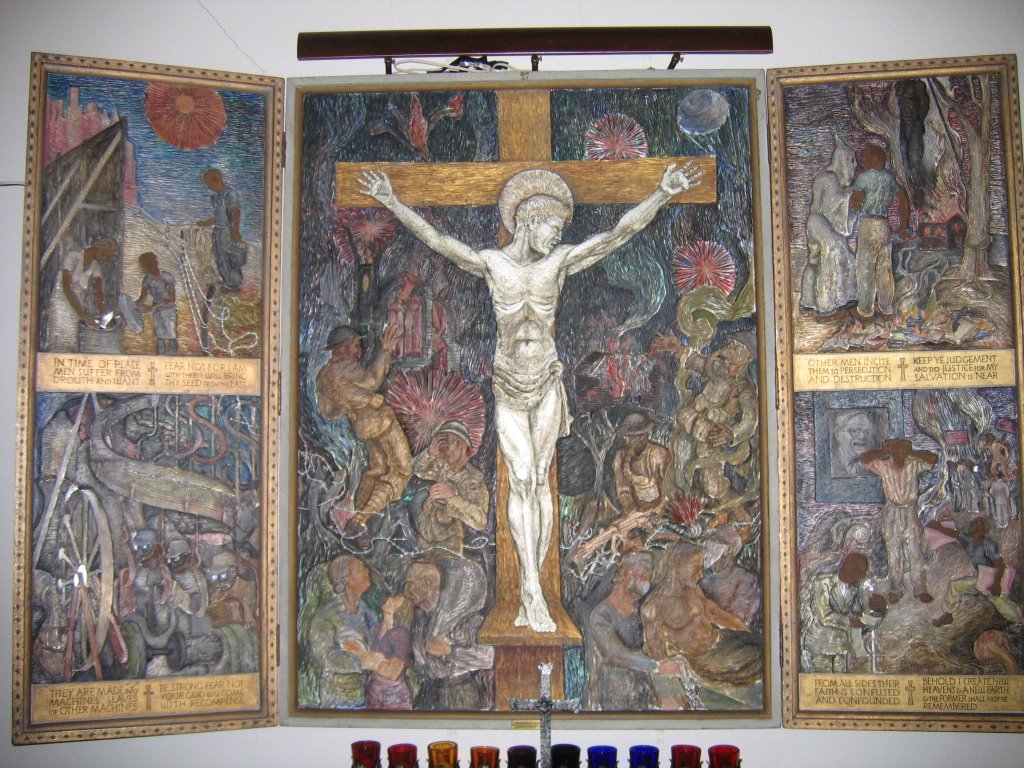
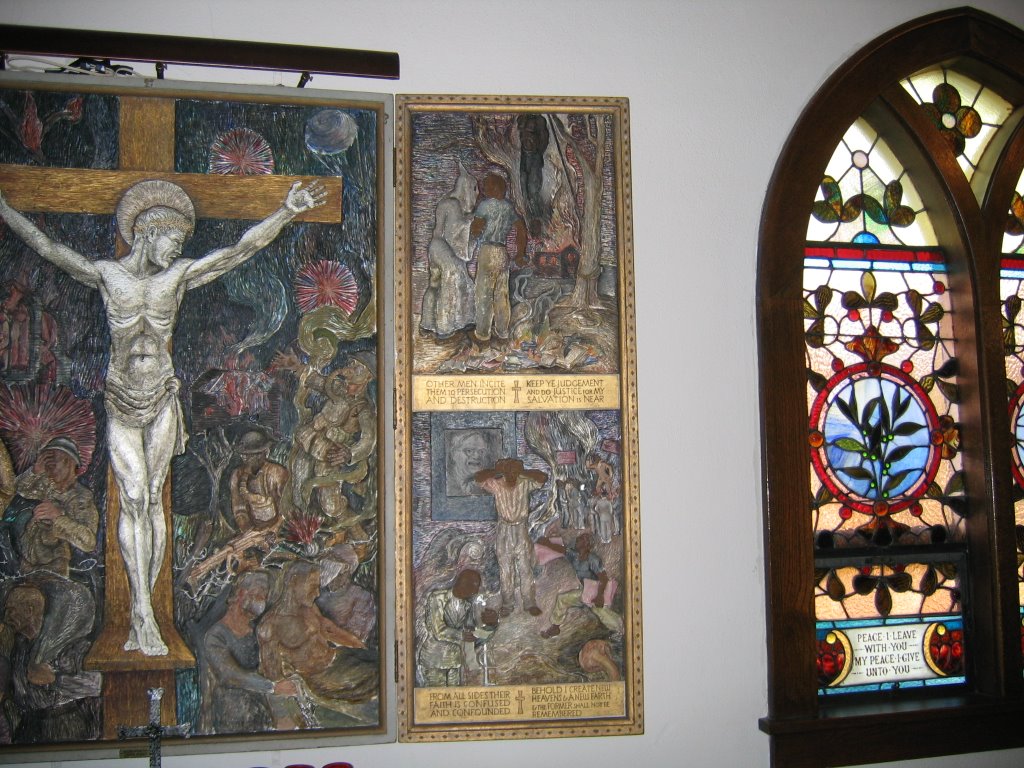
These are some photographs of the tryptich that hangs in the worship space of the Church of the Resurrection where I serve. It is a graphic portrayal of some of the attrocities of the 20th century: mustartd gass in WWI, lynchings, american sweat shops. Over these images hangs Jesus on the cross. This artwork keeps me mindful of two things: 1) Jesus, that is to say God incarnate is present in our suffering, 2) We are to stand with Jesus to change the world to prevent these atrocities.

Thursday, August 17, 2006

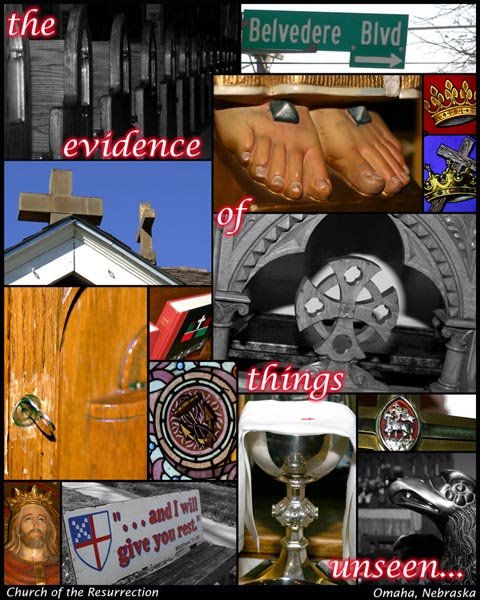
Church of the Resurrection Inspired Collage

This Collage was created by Alison Black, a former Resurrection House intern and COR health minister who now lives in Leavenworth, Kansas with her husband Stephen and their two cats.

A print of this collage will be part of the silent auction at the Resurrection Jam in October.

long time no blog

I haven't blogged in what seems to be a very...very...long...time. In actuallity it has only been about two months, which flew by for me. However, in hindsight, it seems like a life time ago since the end of General Convention 2006. A lot has happened in the passing time with senior high camp and junior camp swallowing most of my attention.

Camps went really well! With the help of some amazing volunteers--especially my wife Jodie--I poured my heart and soul into the camps. All our hard work paid off. From senior high camp where we trained youth as peer ministers we had five outstanding new junior counselors emerge for Junior camp. At Junior camp we had an outstanding time with campers learning to fully rely on God and to share God with each other. The Bishop said to me the other day that when he visited and celebrated at the closing Eucharist he had never seen a group of 4th-8th graders so focused in worship in his life. I am proud of what we did with the camps. Both camps grew by at least 30% and also the Christ centered, participant focus was higher. But...despite all this, I think I might have gotten more out of camp then the campers did.

There are two moments I would like to share: a sun set and a prayer. I was walking back from the activity building to the caffeteria one evening and saw this stupendous sunset. Camp Comeca, a Methodist Facility we rent space from, is located on possibly the only hill in central Nebraska. To get there you are driving along through corn fields and then boom...there's this range of hills with Comeca on top. From atop this hill you can see a great distance because there is nothing to block you line of sight. The corn is high here, but not that high. Possibly, if the skies are clear enough, you might even be able to see Vegas from atop Comeca. Consequently, I had a great view of this sunset!!!! A great view...and it hit me. Right in that moment I had an epiphany. The God that created that sunset, the God that makes stars and planets, atmospheres and colors, hills and corn and human eyes, the God that keeps all these things inbalence so there can be life, the God that is powerful enough to do all cares about little old me. That is grace. Once upon a time a wise man described Grace to me as something good we get that we don't deserve. I certainly do not nor could I do anything to deserve the care or attention of the supreme creating God, but yet I have it. You have it. All have it. Grace, indeed.

The other experience was at our evening prayers one night. We were praying the Song of Simeon, which was first uttered by the prophet Simeon in the Temple at Jesus' presentation eight days after his birth. Simeon recognized God in the infant Jesus. A moment so powerful he was inspired to proclaim,
Lord, you now have set your servant free
to go in peace as you have promised;
for these eyes of mine have seen the Savior,
whom you have prepared for all the world to see:
A light to enlighten the gentiles,
and the glory of your people Israel.
We prayed this prayer at camp and I as looked out at the campers, these small children that carry the light of Christ in them, I was set free as God has promised. I saw God in them, a vision of Hope. Each and everyone one of them has the light of Christ in them, and--in the words of Louis Armstrong--oh, what a wonderful world. What a wonderful world we could have if we inspire these Christ bearing children to share thier light with the world.

God's Peace,
Jason+

Friday, June 23, 2006

Bishop Joe's Summary of General Convention

Below you will find Bishop Joe Burnett's summary of the 75th General Convention of the Episcopal Church USA. Enjoy!

MINISTRY MEMO

A MONTHLY COMMUNICATION
TO Clergy, Wardens and Lay Leaders of the
Diocese of Nebraska
June 23, 2006 (Post General Convention issue!)
From the Bishop

Dear Brothers and Sisters in Christ,

The following is a brief summary of actions from the 75th General Convention of the Episcopal Church, which concluded its nine day triennial gathering in Columbus, Ohio on Wednesday evening, June 21. I will be offering some personal perspectives on these developments which will be sent to you in a separateemail as soon as editing is completed.

This convention was historic, of course, in that the Bishops elected—and the Deputies endorsed the election of—the first female Presiding Bishop, the Rt. Rev. Katherine Jefferts Schori, Bishop of Nevada. Jefferts-Schori has promised to focus on mission in her nine year tenure as Presiding Bishop. Indeed, by far the overarching theme and work of the entire convention focused on global mission and reconciliation. Resolutions calling for the funding and implementation at all levels of the United Nations Millennium Development Goals(MDG) received wide support. Deputies and bishops also addressed issues of violence and poverty in areas of the world under oppression or torn by war and internal violence. Far reaching steps in domestic mission and evangelism, including supporting leadership training and raising funds for new church planting, were also embraced. Clearly worded statements apologizing for the Episcopal Church’s complicity in the historic sin of racism, and specifically in supporting slavery, also called for taking stock of ways in which the church might begin to make amends for past wrongs with living generations of those affected by these actions.

Blessed with the presence of many ecumenical and interfaith representatives,the church took steps to further its conversations and relationships under the auspices of its ecumenical office, and in particular approved an agreement for “interim Eucharistic sharing” (intercommunion) with the United Methodist Church, which includes recognition of the UMC as a member of the one, holy, Catholic and apostolic Church in which the Gospel is rightly preached and taught, and encourages the development of a common Christian life between the two bodies. The agreement permits common, joint celebrations of the Eucharist (Holy Communion) between the two churches.

Deputies also concurred with bishops in adopting a resolution calling for equal representation of women and men on all decision-making bodies within the church at local, diocesan and national levels. This recommendation originated with the 2005 meeting of the Anglican Consultative Council, an international body.

The deputies also concurred with the House of Bishops in a mission initiative resolution for the New Orleans area that will gather data that can be used to advance evangelism elsewhere in the church.

Additional resolutions were passed that came from the special committee that considered resolutions in response to the Windsor Report, a document issued by an international panel of Anglican leaders in response to strains in parts of the world wide Anglican Communion following the consecration in 2003 of an openly gay bishop living in a partnered relationship. The convention affirmed the strong desire of this church to continue as a full and faithful partner in the world wide Anglican communion, while at the same time reiterating the historic separate and independent status of the churches of the Anglican Communion. The "Windsor process" to discern the nature and unity of the church, and the report's call for a listening process, were also affirmed. In particular, the convention approved a resolution that calls on bishops and Standing Committees to "exercise restraint by not consenting to the
consecration of any candidate to the episcopate whose manner of life presents a challenge to the wider church and will lead to further strains on
communion."

Deputies concurred with the House of Bishops in opposing the criminalization of homosexuality, opposing state or federal constitutional amendments that prohibits same-gender civil marriage or civil unions and affirming the civil rights of gays and lesbians. Another resolution reiterates Episcopal Church support of gay and lesbian people as "children of God who have a full and equal claim with all other persons upon the love, acceptance, and pastoral concern and care of the Church."

Deputies also concurred in creating a new task force to study aspects of church disciplinary canons. Proposed changes would have replaced the current court-oriented system with a multi-layered approach intended to focus on mediation and reconciliation which included a controversial provision that would subject certain lay leaders to the new canons. After hearing significant concern about the proposal,particularly about subjecting laity to ecclesiastical discipline,the legislative committee moved to refer the continuing work to the task force for continued revisions over the next three years.

Thank you for your prayers during these long and tiring days. Your deputies and alternates served you and the wider church well in their prayer, work, and
deliberation. We are glad to be home!

Faithfully in Christ,
+Joe